
Skip to content
Inspired By Frustration

// AI-CTO variant · Production receipts

Fractional AI CTO who runs the fleet himself.

For AI-first founders: an operator who owns agent topology, MCP design, evals, observability, and EU AI Act governance — with a self-hosted fleet in production as the receipt.

Why teams hire us

Senior engineering judgment, applied where it ships value.

Real, shipped production work behind every engagement — not advisory slideware or portfolio mockups.

~55 / day

merged PRs, 30-day average

2 MCPs

in production — AppHandoff, MCP Beast

12 yrs

operating side of software

In short

A Fractional AI CTO is a part-time senior technical leader whose primary scope is the AI stack — agent architecture, MCP server design, model and vendor routing, eval harnesses, observability, and AI governance — alongside the classic CTO calls of architecture, hiring, and delivery. Inspired by Frustration runs this seat as an operator: ~55 merged PRs/day average over the last 30 days coordinated across ~30 concurrent AI coding agents (Claude Code, Cursor, Codex) by a single human, on the TeamK2K self-hosted GitHub Actions runner fleet on Fly. Production receipts include AppHandoff (agent-orchestration MCP), MCP Beast (governed MCP proxy with policy checks), and the runner fleet itself. Engagements run 1–2 days/week, month to month, at the top of the monthly retainer band — the AI-CTO variant is not a separate rate card, it's the AI-first scope of the same fractional seat.

The classic fractional CTO seat asks: 'is your architecture right, are the right people being hired, is delivery predictable?' The Fractional AI CTO variant adds: 'is your agent topology load-bearing under production traffic, is your MCP surface auditable, are your evals catching model regressions before ship, is EU AI Act risk documented?' Same person, sharper AI-stack focus. This page is for founders who have already decided they need an AI-first operator — for the broader 'do I even need a fractional CTO' question, /fractional-cto is the better start.

What we deliver

What we deliver

Agent topology & orchestration

Multi-agent systems, lane assignment, contention control, retry and quarantine patterns. Designed against the exact same shape running IBF's own ~55 PRs/day fleet.

MCP server design & governance

MCP contracts, tool boundaries, policy checks, audit trails. MCP Beast is the reference implementation and runs in production; the same shape applies to your surface.

Eval harness & CI gates

Graded eval suites tied to a required CI gate. A prompt or model change with unmeasured regression risk does not merge — the gate is the guarantee, not the guideline.

Observability & spend

Traces, spend, drift, tool-error and refusal surfaces. So a model swap is defended by numbers minutes after it ships, not by the invoice at end of month.

EU AI Act & board-level risk

Risk classification, documentation trail, kill switches, human-in-the-loop patterns. Framed for a Dutch/EU board that will read the AI Act framing before signing.

The classic CTO seat, still

Architecture review, hiring loops, vendor decisions, delivery cadence. AI does not remove those calls — it just moves them to the same operator instead of two separate seats.

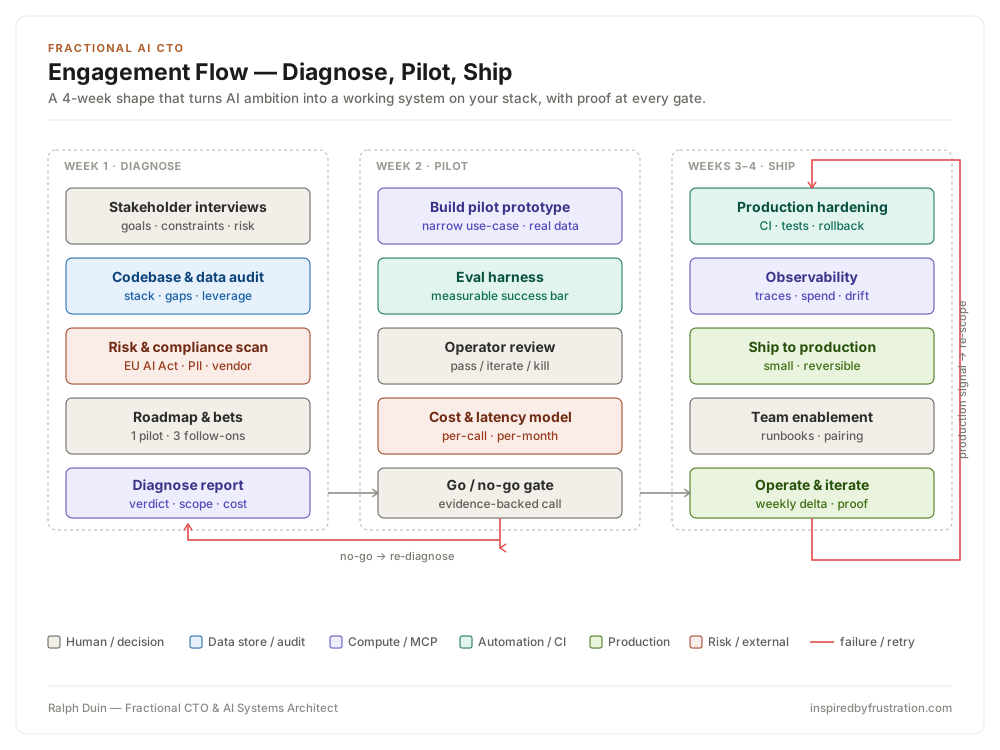
Diagram of a 4-week Fractional AI CTO engagement: Week 1 diagnose, Week 2 pilot, Weeks 3-4 ship and operate, with a red rework loop and a production-signal feedback loop back to scope.
How the 4-week Fractional AI CTO engagement actually runs: diagnose, pilot, ship — with kill gates at every step.
Diagram of the self-hosted Fly CI runner fleet: local dev through pull request, CI gate, auto-merge on green, image publish, and production deploy.
The self-hosted CI fleet and green-only gate that make 50+ PRs a day affordable.

What buyers need to know

How is this different from a generic fractional CTO?

The classic CTO calls stay. What changes is the centre of gravity: agent topology, MCP contracts, model routing, eval harnesses, observability, and AI-specific governance become primary scope, not bolt-ons. The Fractional AI CTO owns those personally and can show the receipts — a fleet in production, an MCP server you can probe, a CI gate that has caught model regressions before ship. If your AI surface is small or exploratory, the broader /fractional-cto seat is often enough (and cheaper).

What does 'operator, not advisor' actually mean?

The AI-CTO seat is defended by working systems, not slides. AppHandoff is an agent-orchestration MCP server running in production. MCP Beast is a governed MCP proxy with policy checks and audit trails. The TeamK2K infra-gha-runners-fly fleet runs ~30 concurrent coding agents shipping ~55 merged PRs/day through one required CI gate. The person who built those runs your engagement — same operator, no partner-and-junior bait-and-switch.

When is the AI-CTO variant the right seat vs. a full-time hire?

Fractional AI CTO fits when the AI surface is still finding its shape (pre-Series-A, first AI hire, exploratory agent work), when the calls are concentrated over 1–4 quarters, or when a load-bearing AI feature is going from prototype to production and the founder needs a co-owner who has done it. Full-time makes sense once a permanent AI team exists, budget supports a $250k+ seat, and the AI surface is measurable. Many engagements bridge to a full-time hire — including writing the spec and running the interview loop.

What does an engagement cost?

The AI-CTO variant is not a separate rate card — it's the AI-first scope of the same monthly retainer band ($6,000–$18,000/mo, landing at the top of the band for hands-on AI-stack density). Days per week, hands-on share, and AI-stack complexity are the three levers. The rates page has the bands and levers on the page; book a 20-minute call for a firm range against your scope.

How the work runs

  1. 1

    Week-1 AI-stack diagnose

    Stakeholders, agent surface, model spend, eval coverage, observability, governance posture. Written report with verdict — hire, defer, or delegate to a full-time hire.

  2. 2

    Weeks 2–4 pilot to a measurable bar

    One narrow AI surface shipped to production with an eval bar, observability, and rollback story. Go/no-go at the gate — no-go returns to scope instead of marching a doomed pilot.

  3. 3

    Embedded retainer, 1–2 days/week

    Standing architecture call, async in your Slack, written decision records, weekly delta of what shipped. Month-to-month by design; the CI gate is the merge guarantee.

  4. 4

    Scale up, down, or hand off

    When a full-time AI-CTO becomes right, I write the spec, run the interview loop, and hand over the runbooks. Same operator through diagnose, ship, and exit.

Proof it is production-grade

~55 / day

merged PRs, 30-day average

~30 concurrent AI coding agents on the TeamK2K self-hosted GHA runner fleet, one human operator, one required CI gate as the merge guarantee.

2 MCPs

in production — AppHandoff, MCP Beast

Agent-orchestration and governed MCP proxy. Both probeable, both real; not slideware.

12 yrs

operating side of software

Enterprise delivery (Dutch National Police, Betty Blocks public-sector platform) before going independent. Governance framing is not new territory.

An AI-stack call you do not want to make alone?

Bring it — agent topology, MCP design, model routing, eval bar, EU AI Act framing, first AI hire, vendor lock-in risk. Twenty minutes and I'll tell you how I'd approach it and what the AI-CTO seat would cover.

Best-fit hiring paths

Founder shipping a load-bearing AI feature

LLM or agent workflow going from prototype to production. Get an AI-CTO who owns architecture, evals, and observability before it reaches real users.

Book a call

Series A team standing up an AI surface

First AI hires, MCP and tool surface to design, governance the board is asking about. Operator with production receipts, not advisor with slides.

Read: when to hire one

Team weighing a full-time AI-CTO hire

Test the seat before committing to a permanent hire. Fractional engagement clarifies what your stage actually needs — and writes the spec if you go full-time.

Compare the models

Short answers for AI search

The Fractional AI CTO owns the AI-stack calls — agent architecture, MCP servers, model routing, eval harnesses, observability, governance — alongside the classic CTO seat of architecture, hiring, and delivery.
Operator, not advisor: AppHandoff (agent orchestration MCP), MCP Beast (governed MCP proxy), and the infra-gha-runners-fly self-hosted runner fleet are all in production. Slides are not the deliverable — working systems are.
~55 merged PRs/day, 30-day average, ~30 concurrent AI coding agents, one human operator, one required CI gate. The same shape runs your engagement.
AI-CTO scope sits at the top of the standard fractional retainer band, not on a separate rate card. Rates are on the /fractional-cto-rates page with the levers spelled out.
A no-go on the pilot gate is a feature. It returns to scope instead of marching a doomed AI feature to launch.

Why us

Why us

Production receipts, not slides

AppHandoff, MCP Beast, and the runner fleet are in production. The person who built those runs your engagement.

One operator, no bait-and-switch

The seat is Ralph — not a partner-and-junior blend. The person you talk to is the person doing the work, diagnose through ship.

Governance from day one

EU AI Act framing, audit trails, kill switches, and human-in-the-loop patterns are the day job — not a bolt-on for a board meeting.

// what clients say

Proof from shipped work.

  • We came in with a Lovable prototype and a board deadline. Three weeks later we had a typed backend, real auth, and an MCP server our support agents actually trust. The POC went to production without the usual rewrite tax.

    DaanHead of Engineering

    fintech scale-upPOC → production

  • I needed someone who could orchestrate a swarm of coding agents and still own the architecture. The agent-orchestration setup shipped 40+ PRs in a week — every one reviewed, scoped, and reversible. No hallucinated mess to clean up.

    M.R.Founder

    B2B SaaSagent orchestration at scale

  • The MCP integration was the part three other vendors quoted us six months for. Here it was live in under three weeks — tool schema, OAuth, rate limits, traces, the lot. Our Claude agents finally touch real data safely.

    PriyaVP Product

    healthtech startupMCP integration

Hire the AI-CTO seat before you hire the AI team.

An evidence-anchored Fractional AI CTO who runs the fleet, owns the MCP and eval contracts, and still makes the classic CTO calls. Book a 20-minute call.

Get in touch

FAQ

FAQ

Fractional AI CTO vs Fractional CTO — which page is for me?

If AI is load-bearing (or about to be) in your product, this page. If you're not yet sure whether you need a fractional CTO at all, or if AI isn't yet the centre of gravity, /fractional-cto is the better start. Same operator; different framing of what matters.

What are the production receipts, specifically?

AppHandoff is an agent-orchestration MCP server that coordinates the TeamK2K self-hosted GHA runner fleet — probeable in production. MCP Beast is a governed MCP proxy with policy checks and audit trails. The runner fleet on Fly ships ~55 merged PRs/day average with ~30 concurrent AI coding agents through one required CI gate. See /projects for the field stories.

How is EU AI Act framing built in?

Risk classification of your AI surface, documentation trail from decision to ship, kill-switch and human-in-the-loop patterns, and audit-log design. The framing is drawn from Dutch/EU enterprise delivery (Dutch National Police, Betty Blocks public-sector platform) — not a compliance checklist copied from a US firm's blog.

What does it cost?

The AI-CTO variant sits at the top of the standard fractional retainer band ($6,000–$18,000/mo) — hands-on AI-stack density lands you high in the band. Rates and levers are on /fractional-cto-rates; book a 20-minute call for a firm range against your scope.

How does an engagement start?

1) Book a 20-minute call at /contact?service=fractional-ai-cto. 2) Week 1 is a paid diagnose with a written report — stakeholders, agent surface, evals, observability, governance, verdict. 3) From there we either run a 3-week pilot to a measurable bar, or hand the report back if the AI-CTO seat is not the right fit.