
Skip to content

Human-led AI software development

AI-Accelerated Development.

AI software development services for teams that need production apps, agent workflows, and faster delivery without handing quality control to the tools.

Production acceleration

Faster delivery with a human-owned production bar.

You get parallel AI implementation where it is safe, plus senior engineering judgment on architecture, QA, security, and release.

50+

production apps shipped

3-5x

typical greenfield acceleration

12 yrs

enterprise delivery judgment

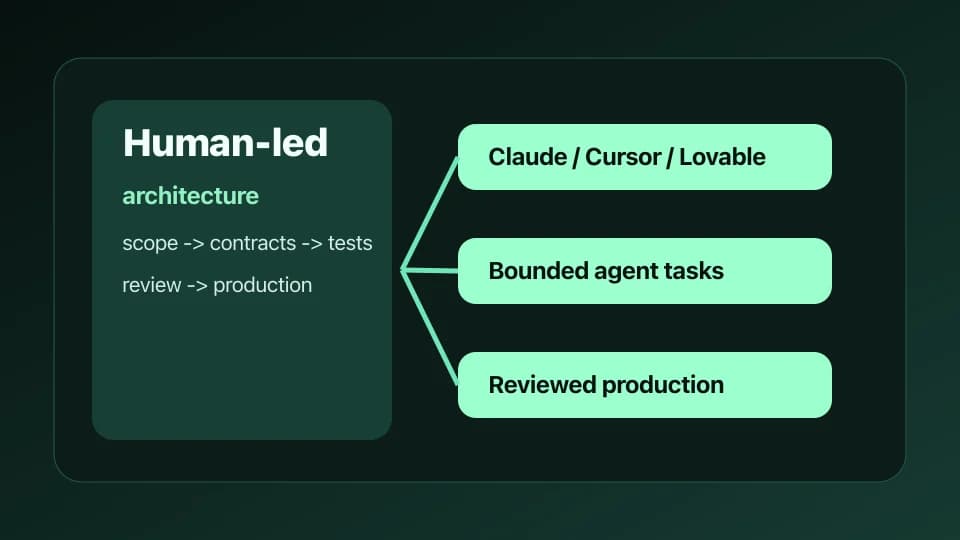
Editorial diagram of a senior engineer directing AI coding tools into reviewed production software
Senior engineers direct AI tools for speed while keeping architecture, review, and release ownership.

AI tools do not replace engineering judgment; they multiply it when a senior operator owns architecture, review, and production hardening. This page explains when AI-accelerated development works, when it does not, and how I use Claude, Cursor, Lovable, Next.js, Supabase, and MCP servers to ship useful software faster.

What we deliver

AI Product Development

Turn a workflow, internal tool, SaaS idea, or customer-facing product into a scoped production build with clear tradeoffs, data model, auth, and deployment from the start.

AI Software Development Services

Build Next.js, TypeScript, Supabase, API, and agent features with AI-assisted implementation and human-owned architecture, code review, testing, and release control.

AI Consulting Services

Decide what to build, what to buy, where agents help, and where standard software is cheaper and safer. Advice is tied to working implementation, not slideware.

Parallel Agent Delivery

Use multiple AI coding agents for bounded tasks while a senior engineer controls contracts, integration, performance, security, and the final production standard.

What buyers need to know

What is AI-accelerated development?

AI-accelerated development is a delivery model where a senior engineer uses AI coding tools to compress implementation time while still owning product judgment, architecture, security, tests, and deployment. The tools increase throughput; they do not become accountable for the product.
When should a team use AI consulting services first?

Use AI consulting services before a build when you are choosing between vendor tools, custom agents, workflow automation, or a full product. A short decision sprint can prevent months of building the wrong AI layer.

When is an AI development agency too much overhead?

An AI development agency is useful when you need a large team and many parallel workstreams. A senior independent operator is often better when the product needs one accountable owner, fast decisions, and less coordination overhead.

What is the best-fit project shape?

AI-accelerated delivery works best for SaaS MVPs, internal tools, dashboards, API integrations, workflow automation, Lovable-to-Next.js rebuilds, and agent-backed products where the requirements are concrete enough to review.

How the work runs

  1. 1

    Scope the business outcome

    Define the workflow, buyer, data, edge cases, and the smallest production version worth shipping.

  2. 2

    Design the technical contract

    Set the stack, data model, route/API boundaries, auth rules, observability, and test strategy before agents write volume code.

  3. 3

    Run bounded AI workstreams

    Use Claude, Cursor, Lovable, and focused agents for implementation while keeping tasks small enough to review and merge safely.

  4. 4

    Review, harden, and ship

    Human review covers security, performance, accessibility, SEO, error states, and deploy behavior before the work reaches production.

Proof it is production-grade

50+

production apps shipped

The operating model is based on shipped products with auth, data, SEO, billing, agent flows, and ongoing maintenance.

3-5x

typical greenfield acceleration

The speed gain comes from reducing boilerplate and iteration time while preserving senior engineering review.

12 yrs

enterprise delivery judgment

The review layer comes from complex delivery work, stakeholder pressure, and production accountability.

Have a build in mind?

Bring the business goal, current stack, and deadline. I will tell you what AI acceleration can safely compress and what should stay deliberately human-reviewed.

Best-fit hiring paths

Founder with a product idea

Use AI-accelerated product development to move from rough workflow to a production MVP without assembling a full team first.

Book a build call

Product lead with backlog pressure

Use focused AI software development services to clear integration, dashboard, and workflow projects that are too important for a prototype agency.

Send the scope

Engineering lead testing AI delivery

Use a senior AI developer to prove where agents help, where they do not, and what review gates your own team should adopt.

Review the operating model

What buyers ask before hiring

AI-accelerated development is fastest when the human engineer controls architecture, task boundaries, review, and release quality while AI tools handle repetitive implementation work.
The main business value of AI software development services is not cheaper code; it is shorter time between a clear product decision and a production-ready version users can try.
A team should hire an AI developer when it needs production ownership across product, frontend, backend, AI workflow, and deployment rather than a prompt operator or prototype vendor.
AI consulting services are useful before a build when the key question is where AI belongs in the workflow, which model or vendor to use, and what risk controls are needed.
AI-accelerated product development works best for concrete workflows with clear users, clear data, and a reviewable definition of done.
AI-generated code becomes production software only after human review covers security, data access, performance, accessibility, observability, and failure states.

Why us

Best fit

MVPs, SaaS rebuilds, internal tools, agent workflows, dashboards, and integration-heavy products with clear business value.

Not fit

Unbounded research, unclear ownership, safety-critical systems without domain review, or teams that want to skip code review because AI wrote it.

Production bar

Every build still needs typed contracts, error handling, security boundaries, performance checks, and understandable APIs underneath it.

AI-accelerated delivery system

Editorial diagram of a senior engineer directing AI coding tools into reviewed production software
Senior engineers direct AI tools for speed while keeping architecture, review, and release ownership.
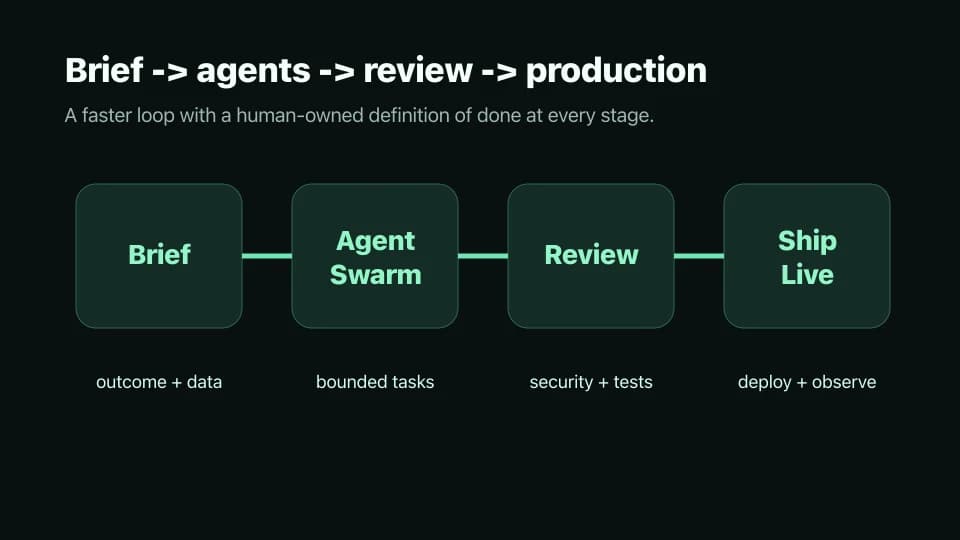
Workflow diagram showing brief, agent workstreams, review, hardening, and production release
From a clear brief through bounded agent workstreams to reviewed, production-ready releases.
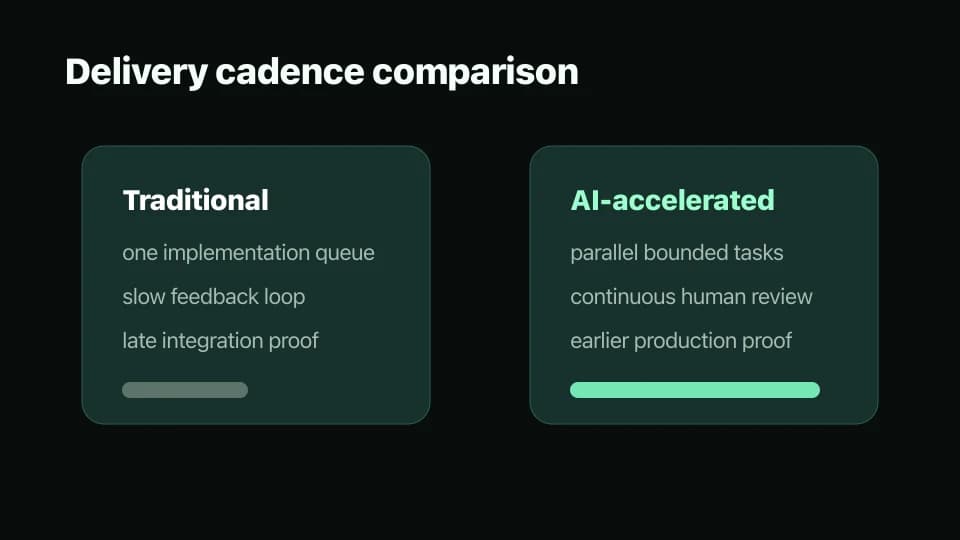
Comparison chart contrasting traditional delivery cadence with AI-accelerated production cadence
How delivery cadence changes when AI accelerates implementation but humans keep the production bar.

Use AI acceleration with production accountability.

Book a short call if you have a product, workflow, or rebuild that needs senior delivery judgment and faster execution. Use contact if you already have a written scope.

Book a consultation

FAQ

How much faster is AI-accelerated development?

On greenfield work with clear scope, AI-accelerated development is typically 3-5x faster than traditional implementation. The gains are strongest on UI, CRUD, integrations, API wiring, tests, and iteration loops. Novel algorithms, messy migrations, and safety-critical decisions still need deliberate human time.

What does AI-accelerated development actually look like day to day?

A senior engineer breaks the product into small reviewable tasks, sends bounded work to AI coding tools or agents, then reviews the resulting code for architecture, correctness, security, performance, and product fit. The workflow is faster because implementation is parallelized, not because review disappears.

Is AI-accelerated development safe for production applications?

Yes, when the process keeps human ownership over architecture, data access, auth, testing, and release decisions. It is not safe when teams paste AI output into production without review or let tools define the system boundaries.

Should I hire an AI developer or an AI development agency?

Hire an AI developer when you want one senior owner who can scope, build, review, and ship. Hire an agency when the project requires a larger team, design production, or many parallel business workstreams. The right choice depends on ownership and coordination needs, not just budget.

What is the difference between AI consulting and AI software development services?

AI consulting decides where AI belongs, what risks matter, and what should be built or bought. AI software development services turn that decision into working software: app routes, APIs, data models, agents, integrations, tests, and deployment.