
Skip to content

Anthropic · OpenAI · MCP-native

AI Agent Development.

Build AI agents that survive contact with production. Tool design, eval harnesses, observability, and MCP-native integrations — by an engineer who ships them.

Most AI agents look great in a demo and break the moment a real user touches them. The difference is not the model — it is the harness around it: tool boundaries, retries, evals, observability, and the unsexy plumbing that turns a clever prompt into a reliable product. I have shipped multiple production agents and MCP servers, and that is the only kind of AI agent development worth paying for.

What we deliver

Custom AI Agent Builds

From brief to deployed agent: tool schema, prompt design, error handling, retries, observability. TypeScript-first, Anthropic and OpenAI friendly.

Agent + MCP Server Pairing

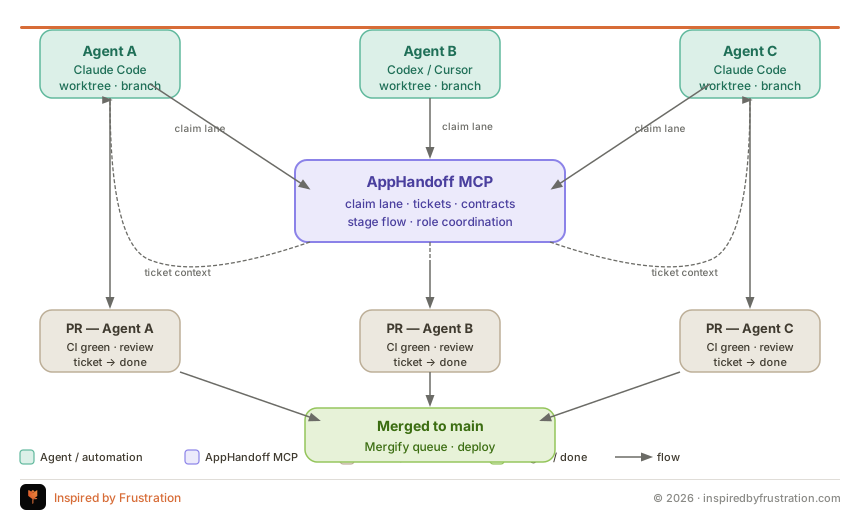
Design the MCP server and the agent that consumes it as a single system. Self-describing tools, idempotent operations, clean failure modes.

Agent Evaluation & Hardening

Build the eval harness that lets you ship changes without regressions: golden tasks, regression suites, structured logging, drift alerts.

Agent Cost Engineering

Reduce cost-per-task without breaking quality: model routing, prompt caching, batched calls, distillation. Real numbers, not hand-waving.

Existing Agent Rescue

Stuck agent project that hallucinates, loops, or burns tokens? Audit, identify the failure modes, and harden the harness. Most rescues take 1–3 weeks.

Why us

Production Agent Track Record

Multiple agents in active production use — billing automation, content pipelines, MCP-driven coordination. Real users, real failure modes, real fixes.

MCP-Native by Default

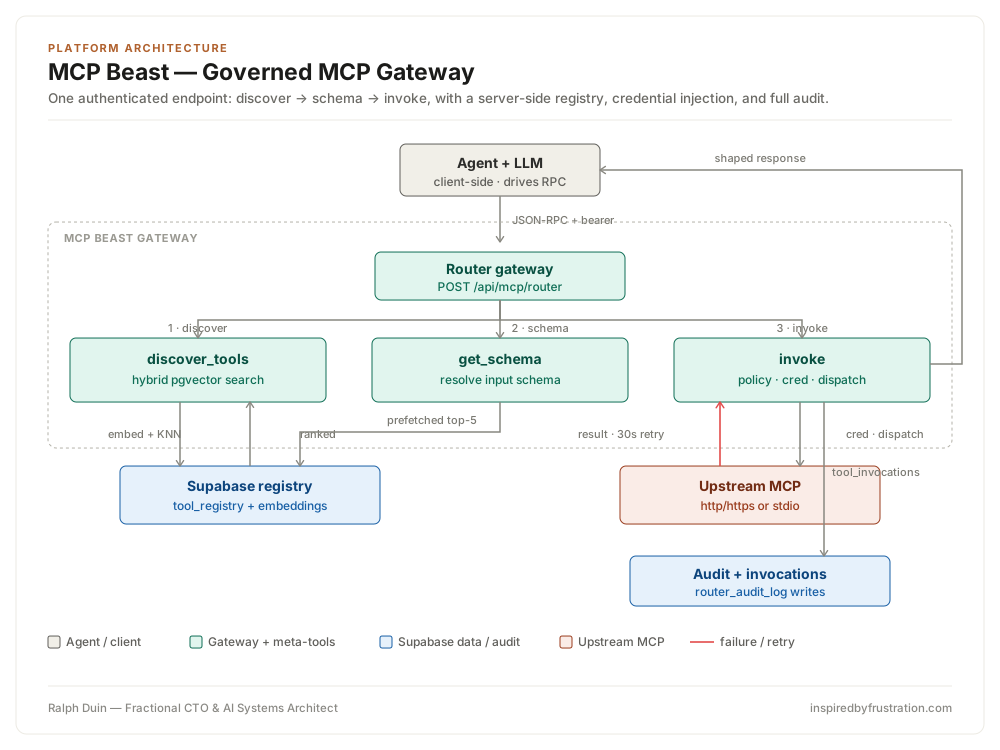
Agents and MCP servers are designed together. Tool boundaries, auth, audit logging, structured errors — engineered as a single system.

Eval-First Mindset

Every agent ships with a regression harness. You can iterate the prompt or swap the model and know within minutes whether quality moved.

Ready to ship an agent that survives production?

Describe the workflow you want to automate and the constraint that's slowing you down. I'll tell you what's realistic, what the first version should look like, and what it'll cost.

Get in touch

FAQ

How do I build an AI agent for my business?

Start by writing the workflow you want the agent to execute as a series of tool calls a junior employee could follow. That document becomes the tool schema. From there: pick a model with strong tool-use (Claude Sonnet 4 or GPT-5-class), wrap each tool with idempotent operations and structured errors, build a small eval harness with 20-50 golden tasks, and ship. Most production agents are 70% plumbing and 30% prompt — invest accordingly.

How much does it cost to build an AI agent?

A focused single-purpose agent (one workflow, 3-8 tools, MCP-native) typically takes 2-4 weeks at €8,000-€18,000. A multi-step business-process agent with auth, eval harness, and observability runs 4-8 weeks at €20,000-€55,000. Enterprise agents with governance, audit trails, and multi-agent orchestration take 8-16 weeks. Ongoing cost-per-task depends on model and traffic — for most production use cases, €0.02-€0.20 per completed task.

What makes a production AI agent different from a demo?

Demos are happy-path showcases; production agents have to survive real users, weird inputs, network failures, and partial tool errors. The difference shows up in five places: idempotent tool design, structured error responses (not opaque exceptions), retries with backoff, an eval harness that catches regressions before they ship, and observability that lets you debug what the agent actually did. Skipping any of these turns a working demo into an outage.

Should I use LangChain, LangGraph, the MCP SDK, or build from scratch?

For most production agents I now reach for the MCP SDK plus a thin TypeScript harness. LangChain is fine for prototyping but becomes friction at production scale. LangGraph is good when you genuinely need stateful multi-agent orchestration, which most teams don't. "From scratch" usually means a few hundred lines of TypeScript that wrap the model client — and is often the right answer for focused agents.

How do I evaluate an AI agent?

Build a golden-task suite: 20-50 task descriptions paired with expected outcomes (or expected tool-call sequences). Run it on every prompt change, every model change, every harness change. Augment with structured logging in production so you can mine real failure modes back into the eval set. Don't rely on "vibe testing" — agents fail subtly and the failures compound.