MCP
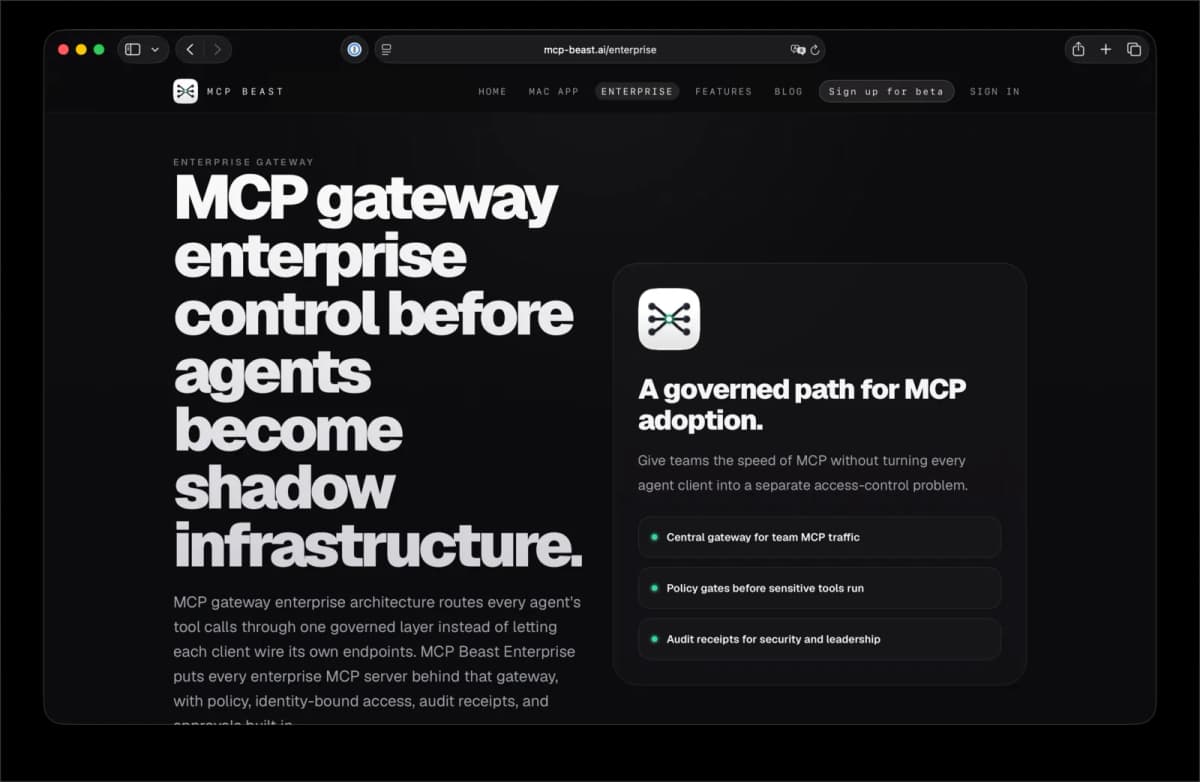
MCP Beast — governed MCP control plane
A control plane for MCP tool calls with architecture, invocation flow, data model, and policy enforcement made visible.
// stack
// area
[ verified outcomes ]
100
MCP servers governed · 345 tools
4
Diagrams
Architecture, invoke path, data model, and policy engine.
proxy
Governance layer
Tool calls route through policy rather than local config only.
MCP proxy
Primary search angle
SERP demand clusters around proxy, gateway, and governance.
[ the case ]
MCP Beast is a governed MCP proxy and control plane: it routes AI tool calls through policy checks, approval rules, audit trails, and shared infrastructure instead of leaving every agent with unmanaged local tools.
MCP Beast is a governance layer for teams that need AI tools without losing control. It centralizes MCP invocation, policy checks, routing, approvals, and auditability so tool access can scale past one-off local setups.
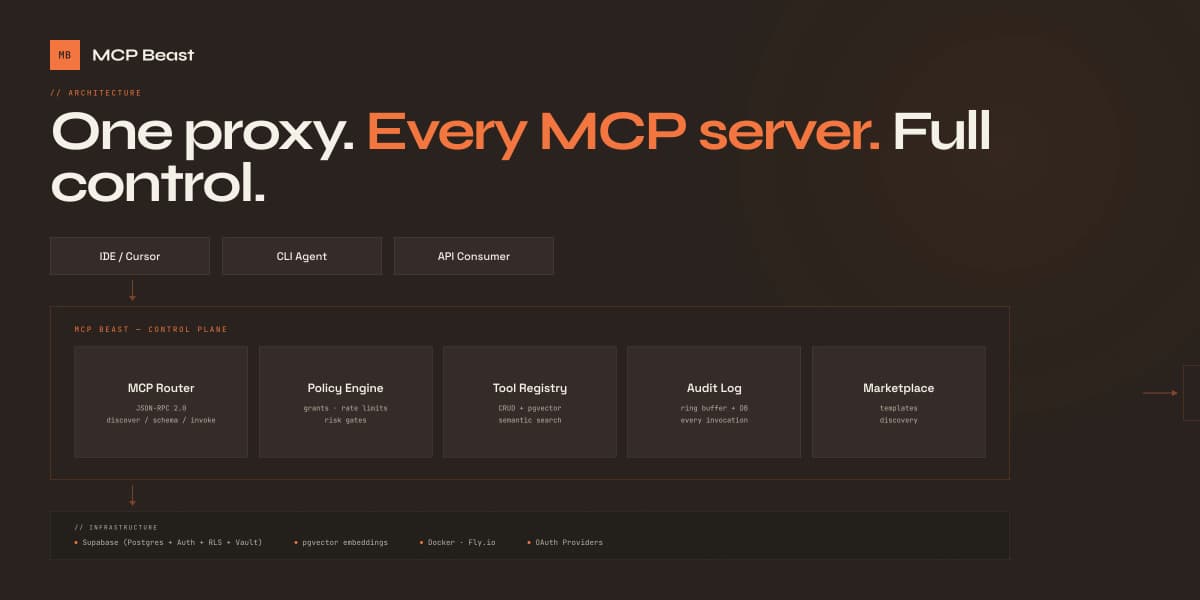
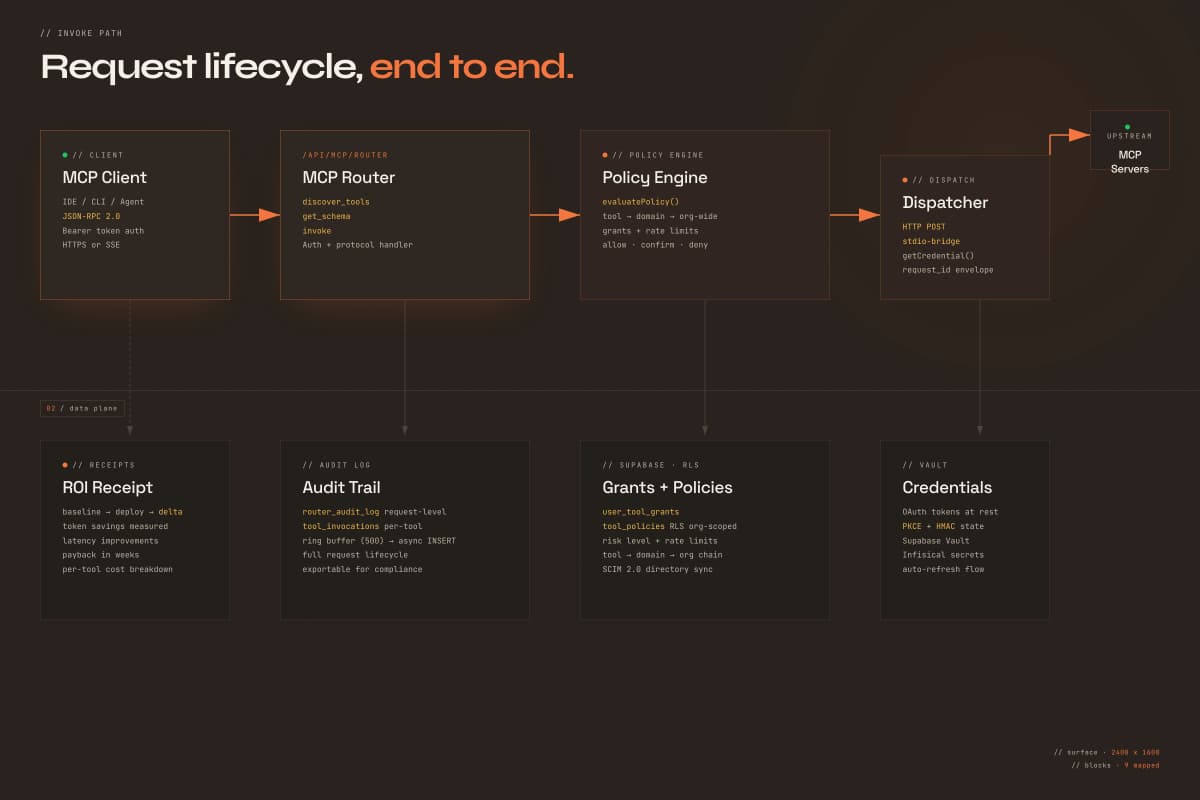
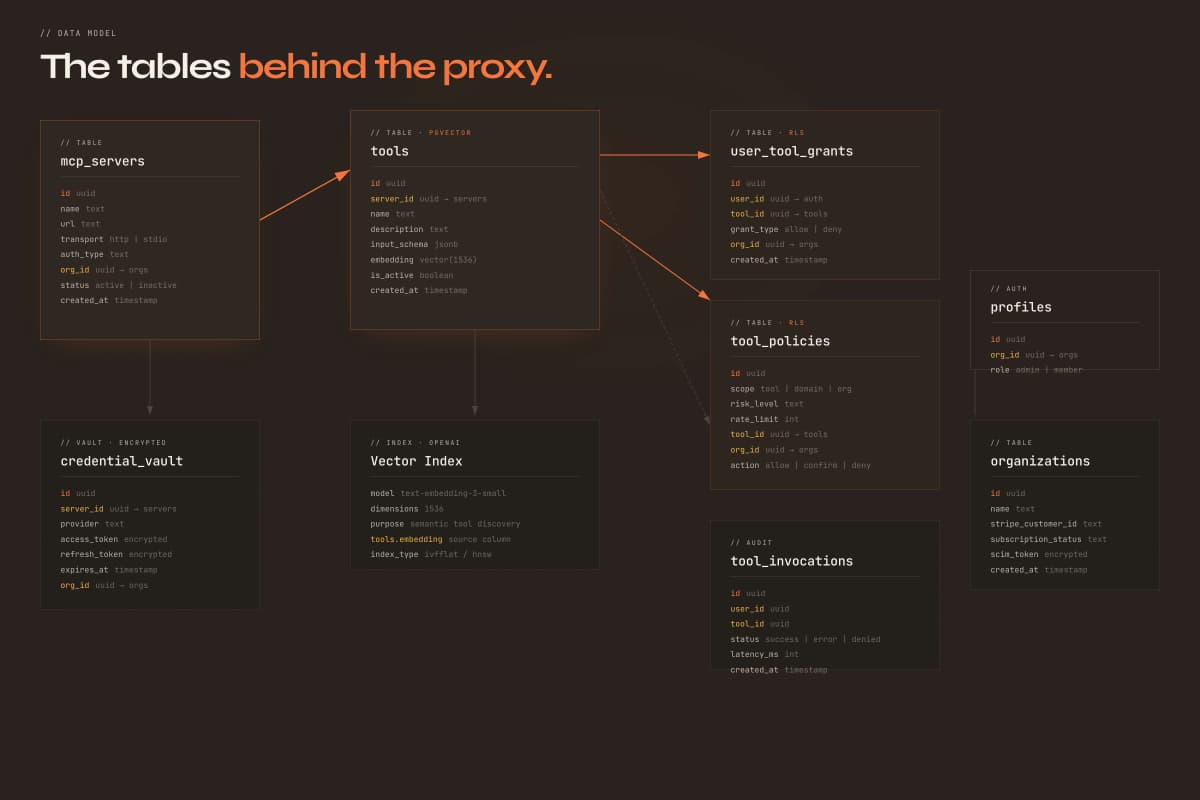
The diagrams are the core proof: architecture, invoke path, data model, and policy engine. They show how a tool call moves through governance rather than disappearing into an opaque agent runtime.
DataForSEO showed live demand around MCP proxy, MCP gateway, and MCP governance questions, so this page now answers those questions directly and positions the project as infrastructure.
Problem
MCP makes tools easier for agents to use, but unmanaged MCP adoption creates a new control problem. Teams need to know which tools exist, who can call them, what data moved, and how to stop unsafe actions.
Local configuration does not scale to enterprise governance. The moment multiple agents, repos, users, and environments are involved, teams need a proxy layer with policy and auditability.
System
MCP Beast sits between agents and MCP servers. A tool invocation enters the proxy, receives identity and policy context, passes through approval or denial rules, then produces an auditable execution record.
The data model supports tools, servers, policies, invocations, approvals, and usage records. The policy engine is the core differentiator because it turns MCP from a convenience layer into governed infrastructure.
What shipped
The case study includes four diagram exports: architecture, invoke path, data model, and policy engine. Together they explain how the product works at system level before a reader ever sees UI screenshots.
The public page now uses those diagrams in the gallery and adds the missing explanatory copy around each system decision.
SEO angle
DataForSEO returned People Also Ask questions including what is an MCP proxy, who governs MCP, and the difference between MCP proxy and MCP gateway. The page now answers those directly in the FAQ and answer-first block.
- Architecture diagram: shows agents, proxy, policies, MCP servers, and audit storage as separate responsibilities.
- Invoke path diagram: shows the runtime sequence for a tool call from request to decision to execution.
- Data model diagram: explains the records needed for governance and traceability.
- Policy engine diagram: makes allow, deny, approve, and audit behavior explicit.
// search questions
What is an MCP proxy?
An MCP proxy sits between AI agents and MCP servers. It can centralize routing, policy checks, approvals, credentials, logging, and auditing instead of letting every agent connect directly to every tool.
What is the difference between an MCP proxy and an MCP gateway?
The terms overlap. A gateway often emphasizes connection and routing, while a proxy can also emphasize mediation: policy enforcement, audit trails, approvals, and request shaping.
Who governs MCP tool access?
In a mature setup, tool access is governed by the organization through policies, identity, environment rules, and audit requirements. MCP Beast is designed to make that governance visible and enforceable.
// continue with the real product
[ product evidence ]
[ build something like this ]
Have a similar bottleneck? Turn it into shipped proof.
Same operator and green-gate build process behind MCP Beast — governed MCP control plane. One brief, one ship — replies within 24h.