MCP
AppHandoff — MCP bridge for AI-built apps
A coordination layer that turns Lovable prototypes into production engineering handoffs with MCP, contract scans, and human approval flow.
contract v2.1 / synced
Auth guard on dashboard route
Sync OpenAPI spec to v2.1
GET /users/:id missing endpoint
Stripe coupon code field
POST /billing/checkout shape mismatch
E2E tests for checkout flow
Dark mode toggle persistence
PATCH /projects/:id required field
Webhook retry on 5xx from Stripe
OG image regenerator script
Login redirect on mobile Safari
MCP tool: list_projects pagination
// stack
// area
[ verified outcomes ]
11×
smaller MCP payload (compact mode)
1
MCP surface
A dedicated tool interface for agents and production workflows.
5
Workflow stages
Intake, scan, review, implementation, and closure.
handoff drift
Primary risk reduced
The product preserves context before engineering starts.
[ the case ]
AppHandoff is an MCP-powered production handoff system for AI-built apps: it captures what Lovable or an agent produced, checks it against implementation contracts, and gives engineers a reviewable path from prototype to shipped code.
AppHandoff is the coordination layer between AI-generated product work and the production engineers who need to turn it into durable software. The product combines an MCP server, contract-aware scans, project state, and human approval so teams can move faster without losing accountability.
The project page now treats the handoff as the product: intake, scan, review, implementation, and closure are visible as one workflow rather than a pile of chat messages and disconnected tickets.
Search data showed that generic AI handoff queries are polluted by construction-estimating tools, so the page is positioned around Lovable MCP, production handoff, and engineering coordination rather than broad handoff software.
Problem
AI app builders can create impressive surfaces quickly, but the next team often receives a vague bundle of screenshots, generated code, and intent hidden in chat history. That creates slow reviews, missed backend assumptions, and repeated clarification cycles.
The hard part is not only generating the app. It is preserving enough context for a production engineer to understand what changed, what still needs a human decision, and what can safely move forward.
System
AppHandoff packages handoff state into a workflow: project intake, scanner output, contract checks, human review, and ticket state. The MCP path means agents can ask for structured project context instead of scraping a UI or guessing from a repo tree.
The product is intentionally explicit about human approval. It does not pretend every decision should be automated; it makes the handoff durable enough that humans can approve, reject, or redirect with the right context visible.
What shipped
The production system includes a Next.js backend and MCP server, a frontend workflow surface, Supabase-backed persistence, Fly deployments, GitHub Actions release gates, and documentation that keeps agents aligned with the same workflow humans use.
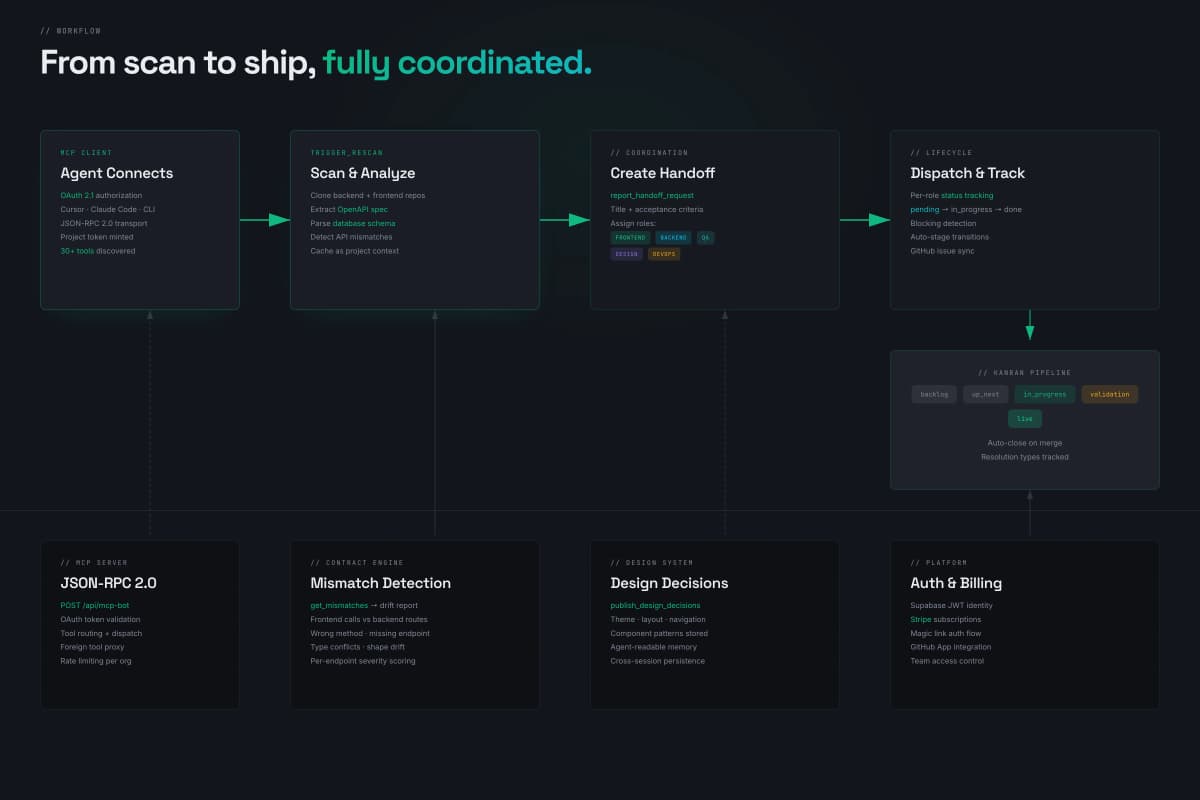
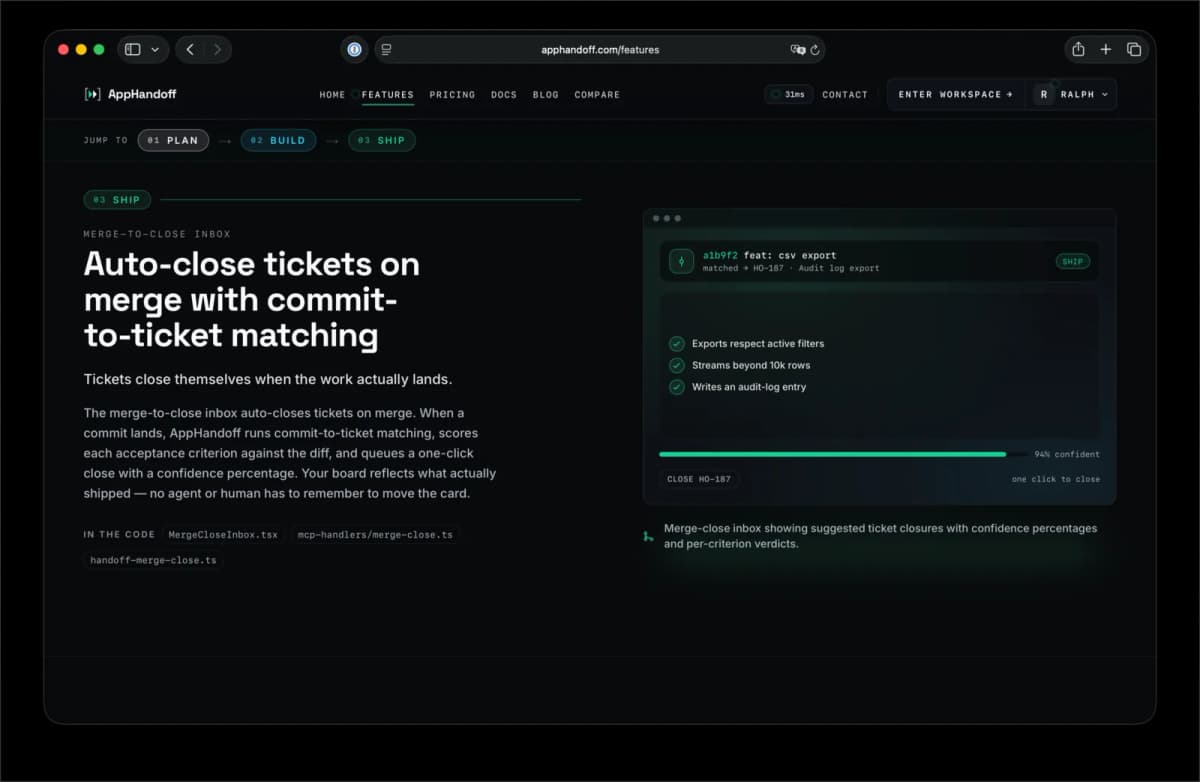
The case-study diagram in the gallery shows the actual workflow shape: builder intent enters, scans and contracts normalize the work, and engineering receives a clearer implementation lane.
SEO angle
DataForSEO showed the strongest SERP fit around Lovable MCP server and MCP integration queries, with Lovable documentation and GitHub examples ranking. The page therefore answers the practical question: how does a Lovable build become production engineering work?
The copy avoids the broader phrase AI handoff software as the main target because that SERP is dominated by unrelated construction estimating tools.
- The AppHandoff flowchart should be read left to right: AI build intent becomes structured project state before engineering action.
- The diagram belongs early in the gallery because the workflow is the core product, not decorative documentation.
// search questions
What is a Lovable MCP server?
A Lovable MCP server is a tool interface that lets AI agents work with Lovable-related project context or actions through the Model Context Protocol. In AppHandoff, MCP is used to make handoff state queryable and actionable for production engineering workflows.
How does AppHandoff differ from a normal project brief?
A brief is usually static. AppHandoff keeps handoff state connected to scans, tickets, approvals, and implementation context so the engineering team can keep working from the same source of truth.
// continue with the real product
[ product evidence ]
[ build something like this ]
Have a similar bottleneck? Turn it into shipped proof.
Same operator and green-gate build process behind AppHandoff — MCP bridge for AI-built apps. One brief, one ship — replies within 24h.