 Inspired By Frustration
menu
// Hypothesis · POC · Eval · Pilot · Production
Generative AI Implementation.
A generative AI consultant who builds the working system on your stack — pilot to production, with a measurable bar and a kill gate at every stage.
In short
Generative AI implementation is the work of turning a pilot into a production system: hypothesis, POC, eval harness, pilot, production, monitor.
- We run all six stages on your stack, with a measurable bar at each step and a kill gate when it isn't met.
- Receipts, not slides — 100 PRs/day, one operator.
Most generative AI pilots die at the wall — somewhere between a working demo and a production system that survives Friday traffic.
The pattern is always the same: no eval harness, no kill gate, prod context never modelled, cost and latency only measured at the end.
We run a different shape.
Each stage has a number it has to clear before the next stage starts, and the work kills itself back to hypothesis when it doesn't.
That capsule is the whole engagement in miniature.
What we deliver
Hypothesis & POC
Name the bet in one sentence. Build the smallest test that can falsify it — real data, real model, no UI polish. Two weeks, not two months.
Eval harness
Labelled golden set, graded outputs, repeatable runs. The measurable bar is the difference between a demo and a system. We build it before the pilot, not after.
Pilot with real users
Narrow scope, real users, full observability. Prompt and model choices recorded; cost and p95 latency measured per call. Kill gate decides whether it ships.
Production hardening
Guardrails, retries, circuit breakers, audit log. Required CI checks, rollback path, on-call runbook. Small, reversible deploys on your existing stack.
Monitor & iterate
Traces, spend, drift, refusal rate. Weekly delta against the eval bar. A signal from production routes back to the pilot — not to a budget review.
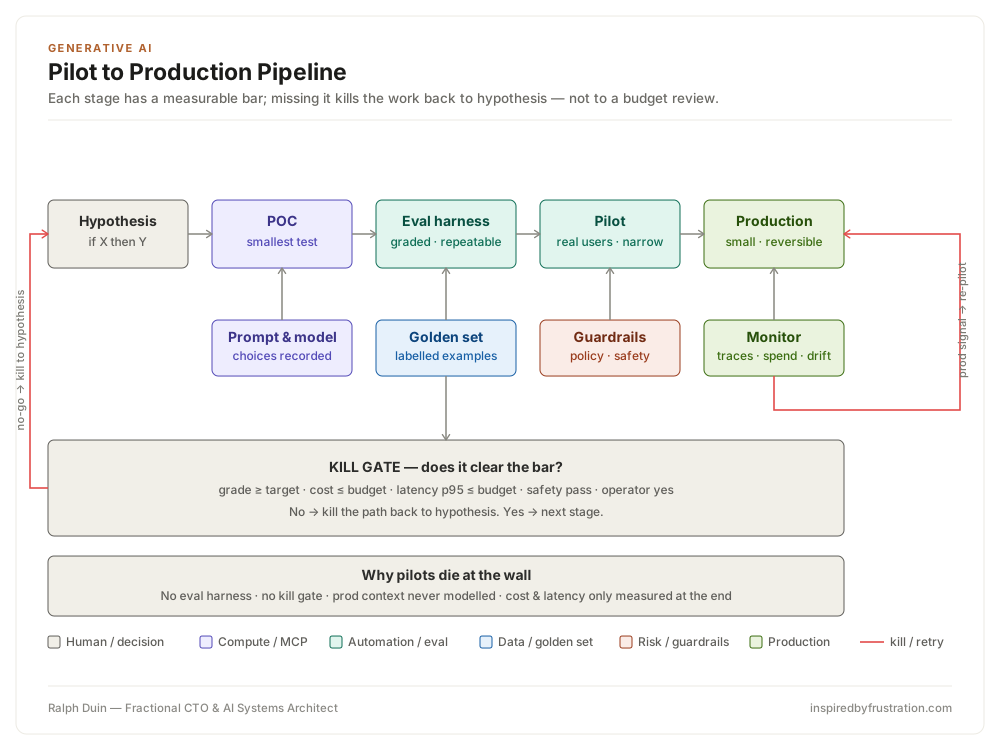
How the work runs
- 1
Hypothesis
If X then Y, in one sentence. Falsifiable, with a measurable bar.
- 2
POC
Smallest test, real data, real model. Two-week box.
- 3
Eval harness
Golden set, graded, repeatable. The bar is the bar.
- 4
Pilot
Narrow real-user scope. Cost, latency, refusal recorded per call.
- 5
Production
Small, reversible deploys. Required checks. Rollback path.
- 6
Monitor
Traces, spend, drift. Weekly delta. Signal routes back to hypothesis.
Pilot stuck at the wall? Bring it.
Tell us where the bar is missing — eval, latency, cost, safety, or context — and we'll tell you what the next stage actually costs to ship.
Why us
Implementation-first
We write the code. The deliverable is a working system, not a roadmap deck. Every claim on this page is something the engagement actually ships.
Evidence at every stage
Eval grades, cost per call, latency p95, refusal rate — recorded, not asserted. If we can't defend it in a review, it doesn't go past the kill gate.
Operator voice, not vendor pitch
One operator runs the fleet that ships this. Same hands on your build. No reseller margins, no implementation-partner kickbacks, no juniors.
// what clients say
Proof from shipped work.
We came in with a Lovable prototype and a board deadline. Three weeks later we had a typed backend, real auth, and an MCP server our support agents actually trust. The POC went to production without the usual rewrite tax.
DaanHead of Engineering
fintech scale-upPOC → production
I needed someone who could orchestrate a swarm of coding agents and still own the architecture. The agent-orchestration setup shipped 40+ PRs in a week — every one reviewed, scoped, and reversible. No hallucinated mess to clean up.
M.R.Founder
B2B SaaSagent orchestration at scale
The MCP integration was the part three other vendors quoted us six months for. Here it was live in under three weeks — tool schema, OAuth, rate limits, traces, the lot. Our Claude agents finally touch real data safely.
PriyaVP Product
healthtech startupMCP integration
From pilot to production — on your stack, with a measurable bar.
Bring the use-case and the constraint. We'll diagnose the missing stage, write the eval harness, and ship the system that clears it.
Put us to workFAQ
What does generative AI implementation actually involve?
Six stages: hypothesis, POC, eval harness, pilot, production, monitor. Each stage has a measurable bar — eval grade, cost per call, latency p95, safety pass — and a kill gate when it isn't met. The deliverable at each stage is a working system on your stack, not a slide. Most of the work is the eval harness and the guardrails — that is what turns a demo into infrastructure.
How is a generative AI consultant different from an AI strategy consultant?
A strategy consultant tells you which bet to take. A generative AI consultant ships the bet. We do both, but the centre of gravity is implementation: prompts, models, evals, guardrails, observability, deploys. If the engagement ends without a working system in production, it didn't work. Strategy without implementation is slideware; implementation without strategy is wasted runway.
What does a generative AI implementation cost?
Rate bands published separately — request a 20-minute call for a range against your scope. The cost lever is the eval harness and the kill gate: a clear bar lets us hit production in weeks; a fuzzy bar drags pilots into a budget review. Pilots typically run two to six weeks; production hardening runs four to twelve weeks depending on integration surface, data sensitivity, and traffic shape.
Why do generative AI pilots die at the wall?
Four failure modes, every time: no eval harness so quality is unmeasured; no kill gate so the work drags; prod context never modelled so latency, cost, and refusal rate are surprises at the end; and guardrails bolted on after the demo instead of designed in. The pilot looks fine in a demo and falls over in production. We design the kill gate first to prevent that pattern.
How do we start a generative AI implementation engagement?
Three steps. 1) Send a message naming the use-case in one sentence — you get a reply within 4 waking hours on weekdays. 2) We run a two-week diagnose to write the hypothesis, the eval bar, and the cost-and-latency budget. 3) We start the POC against that bar — and the kill gate decides whether it becomes a pilot.