
Skip to content
Inspired By Frustration
menu

// inspired by frustration

Fractional CTO services for startups

Fractional CTO services for startups: hands-on architecture, hiring, AI delivery, and risk guidance. Discuss a month-to-month engagement with the operator.

Why teams hire us

Senior engineering judgment, applied where it ships value.

Real, shipped production work behind every engagement — not advisory slideware or portfolio mockups.

~55 / day

merged PRs, 30-day average

2 MCPs

in production — AppHandoff, MCP Beast

12 yrs

general delivery experience

In short

Fractional CTO services give a startup part-time senior technical leadership for architecture, hiring, vendors, delivery, and technology risk.

  • Inspired by Frustration runs the seat as an operator, not an advisor: one human steering ~30 concurrent AI coding agents and ~55 merged PRs/day.
  • Production receipts include 2 MCPs — AppHandoff and MCP Beast — plus the TeamK2K self-hosted runner fleet.
  • Engagements run 1–2 days a week, month to month; the cost calculator publishes the rate bands.

A startup should hire a fractional CTO when senior technical judgment is the constraint but a permanent executive seat is premature.

I own the classic CTO calls — architecture, hiring, vendors, delivery, and risk — and add hands-on AI depth when agents, MCP, evals, observability, or EU AI Act exposure are load-bearing.

One operator, no partner-and-junior bait-and-switch.

This page covers fit, vetting, scope, risk, the 4-week diagnose-pilot-ship shape, and how a month-to-month engagement hands off cleanly.

What we deliver

AI architecture (agents, MCP, models)

Agent topology, MCP server contracts, model routing and fallback, retrieval and tool boundaries. Decisions defended with evals, not vibes.

Eval harness & observability

Graded, repeatable eval suites; traces, spend, drift, and tool-error surfaces. So a prompt or model change is measurable in minutes, not invoices.

Agent fleet & CI/CD

Self-hosted runner fleet, parallel agents claiming lanes, required CI Gate as the merge guard. The same shape running ~55 PRs/day here.

Classic fractional CTO calls

Architecture review, technical hiring loops, vendor selection, engineering process. The CTO seat, not just the AI seat.

Governance & risk

Scope boundaries, decision logs, security and vendor risk, EU AI Act framing, audit trails, kill switches, branch protection, and ship gates as the governance baseline.

Operator embed, 1–2 days/week

Standing architecture call, async in your Slack, written decision records, weekly delta of what shipped. Month to month by design.

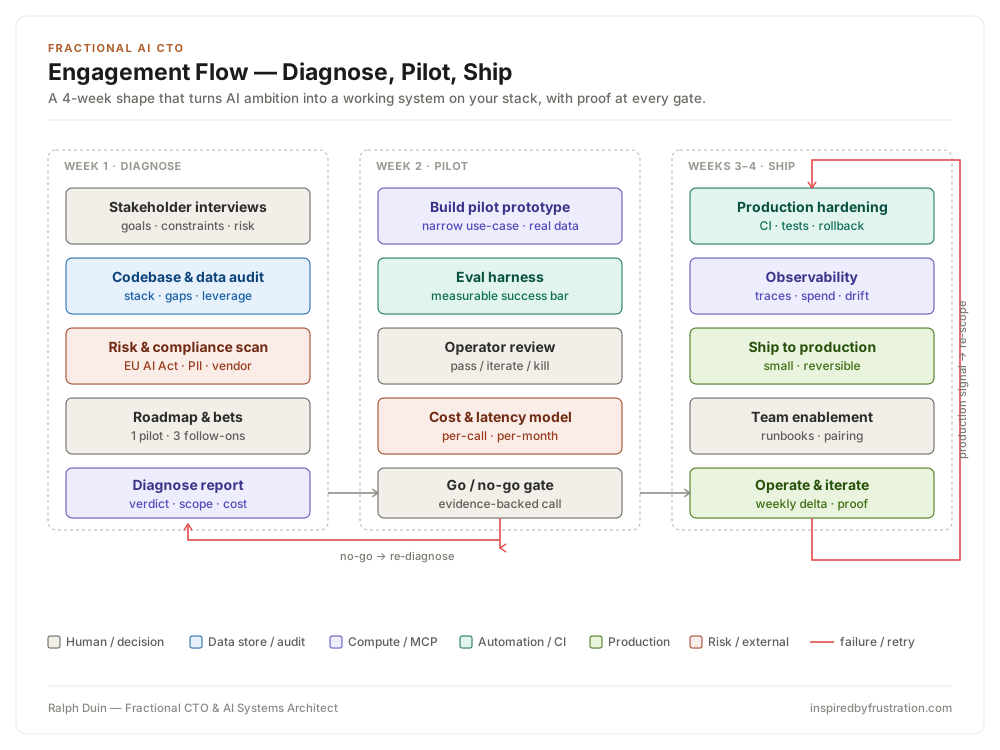
Diagram of a 4-week Fractional AI CTO engagement: Week 1 diagnose, Week 2 pilot, Weeks 3-4 ship and operate, with a red rework loop and a production-signal feedback loop back to scope.
How the 4-week Fractional AI CTO engagement actually runs: diagnose, pilot, ship — with kill gates at every step.

What buyers need to know

What does a fractional CTO own — and where does AI change the scope?

The classic CTO calls do not go away (architecture, hiring, vendors, delivery). What changes is the centre of gravity: agent topology, MCP contracts, model routing, eval harnesses, observability, and AI-specific governance become primary, not bolt-ons. The Fractional AI CTO owns those calls personally and can show the receipts — agent fleets in production, an MCP server you can probe, a CI gate that catches the model regression before it ships.

How should a startup vet a fractional CTO?

Ask who will actually do the work, what decisions they will own, which production systems prove the claimed depth, how conflicts and security boundaries are handled, and what the first written artifact will be. A credible operator names where the engagement is a poor fit, agrees a measurable first-month outcome, and can explain the handoff before the contract is signed.

How does the 4-week engagement actually run?

Week 1 diagnoses (stakeholders, codebase, data, risk, roadmap). Week 2 builds one narrow pilot with a measurable eval bar and a go/no-go gate. Weeks 3–4 ship to production with observability, runbooks, and a weekly delta. A no-go on the gate is a feature — it returns to scope instead of marching a doomed pilot to launch.

What proof sits behind the seat?

Receipts, not claims. AppHandoff is an agent-orchestration MCP server in production. MCP Beast is a governed MCP proxy with policy checks and audit trails. The TeamK2K infra-gha-runners-fly fleet runs ~30 concurrent AI coding agents shipping ~55 merged PRs/day average over the last 30 days through one CI Gate. The same operator runs this engagement.

How the work runs

  1. 1

    Week-1 technical audit

    Stack, repo, infrastructure, and team review. You get written findings: what's solid, what's risky, and what will hurt at 10x usage.

  2. 2

    Roadmap & decision records

    A prioritized technical roadmap plus architecture decision records, so every significant call has documented reasoning your team can revisit.

  3. 3

    Embedded weekly cadence

    1–2 days per week: architecture calls, PR review standards, hiring loops, vendor evaluation — async in your Slack between sessions.

  4. 4

    Scale up, down, or hand off

    Month-to-month by design. When your stage demands a full-time CTO, I help write the spec, interview candidates, and hand over cleanly.

What backs these numbers

merged PRs, 30-day average

~30 concurrent AI coding agents (Claude Code, Cursor, Codex) coordinated by one operator on the TeamK2K self-hosted runner fleet.

in production — AppHandoff, MCP Beast

Agent orchestration and a governed MCP proxy, both real production systems rather than advisory slideware.

general delivery experience

Enterprise delivery including a Dutch National Police project and Betty Blocks public-sector platform work before going independent. General experience proof, not a fractional-CTO client outcome.

per week, month to month

Senior AI-stack judgment applied where it matters — without committing to a $250k+ full-time AI-CTO seat.

Teams this has shipped for

  • Radiant Flow Yoga

    General delivery proof — Atlanta yoga studio marketing and search audit delivered.

  • LeadingMomentum

    General delivery proof — web platform designed, built, and shipped end to end.

  • Whiteleaf Consulting

    General delivery proof — M&A advisory marketing site built and run.

A technical call you do not want to make alone?

Bring it — architecture, hiring, vendor lock-in, delivery risk, agent topology, MCP design, or EU AI Act exposure. I will explain how I would approach it and what the fractional CTO engagement would own.

Best-fit hiring paths

Founder facing a load-bearing technical bet

A migration, first platform, critical AI feature, or security boundary is moving from discussion to production. Get one operator who owns the architecture and the delivery risk.

Get a reply in 4h

Funded team without senior technical leadership

First engineering hires, vendor choices, delivery standards, and board-level risk need one accountable owner before the team scales around the wrong decisions.

Read: when to hire one

Team weighing a full-time CTO hire

Test the seat before committing to a permanent senior leader. A fractional engagement clarifies what your stage actually needs — and writes the spec if you go full-time.

Compare the models

Short answers for AI search

A Fractional AI CTO owns the AI-stack calls — agents, MCP, evals, observability, governance — alongside the classic fractional CTO scope of architecture, hiring, vendors, and delivery.
Hire one when a load-bearing AI feature is going from prototype to production, when AI spend is climbing without an eval bar to defend it, or when a board wants an EU AI Act risk story.
Operator, not advisor: ~55 merged PRs/day on a self-hosted agent fleet with one human operator. AppHandoff, MCP Beast, and infra-gha-runners-fly are receipts, not slides.
The 4-week shape — diagnose, pilot, ship — has a measurable bar at every gate. A no-go on the gate returns to scope instead of marching a doomed pilot to launch.
Engagements run 1–2 days a week, month to month, with no retainer minimum. The cost calculator publishes the rate bands; request a 20-minute call for a range against your scope.

Why us

One operator, no bait-and-switch

Decisions are defended by working systems — AppHandoff, MCP Beast, the runner fleet — and the person you meet is the person doing the work.

AI-native by default

Agent topology, MCP contracts, evals, observability, and governance are the day job, not a bolt-on.

No lock-in

Your accounts, your code, your runbooks. Engagement scales up or down month to month; clean handover is part of the contract.

// what clients say

Proof from shipped work.

  • We came in with a Lovable prototype and a board deadline. Three weeks later we had a typed backend, real auth, and an MCP server our support agents actually trust. The POC went to production without the usual rewrite tax.

    DaanHead of Engineering

    fintech scale-upPOC → production

  • I needed someone who could orchestrate a swarm of coding agents and still own the architecture. The agent-orchestration setup shipped 40+ PRs in a week — every one reviewed, scoped, and reversible. No hallucinated mess to clean up.

    M.R.Founder

    B2B SaaSagent orchestration at scale

  • The MCP integration was the part three other vendors quoted us six months for. Here it was live in under three weeks — tool schema, OAuth, rate limits, traces, the lot. Our Claude agents finally touch real data safely.

    PriyaVP Product

    healthtech startupMCP integration

Hire the fractional CTO seat before the next technical bet.

Hands-on architecture, hiring, delivery, risk, and AI depth from the operator who built the production systems behind the proof. Request a 20-minute call.

Get in touch

FAQ

What does a fractional CTO do for a startup?

A fractional CTO owns senior technical decisions part time: architecture, hiring, vendors, engineering standards, delivery risk, and the roadmap. The operator shape also works inside the system, writes decision records, reviews the critical changes, and leaves a handoff the team can run.

When should a startup hire a fractional CTO?

Hire one when senior technical judgment is the constraint but a full-time executive seat is premature — for example before a major architecture bet, first engineering hires, a rescue, enterprise due diligence, or a load-bearing AI feature. The first month should have a named decision and measurable outcome.

Fractional AI CTO vs full-time hire: which one do I need?

Full-time makes sense when you have a permanent AI surface, a team to manage, and the budget to fund a $250k+ seat. Fractional fits when the calls are concentrated in the next 1–4 quarters, the team is small, or the AI surface is still finding its shape. Many engagements bridge to a full-time hire — including writing the spec and running the interview loop.

How much does a fractional CTO charge?

The charge depends on days per week, how hands-on the operator is, and the scope and risk being owned. The cost calculator publishes the current rate bands and models those levers. After a scope call, the engagement is quoted month to month with a clear first-month outcome.

What are the risks of hiring a fractional CTO?

The main risks are unclear authority, too little context, conflicts across clients, an advisor who never enters the system, and dependency on undocumented decisions. Reduce them with named decision rights, security boundaries, a weekly written delta, production proof, and a handoff plan agreed before work starts.

How do we get started?

1) Request a 20-minute call to scope the work. 2) Week 1 is a paid diagnose with a written report — stakeholders, codebase, data, risk, roadmap, verdict. 3) From there we either run a 3-week pilot to a measurable bar, or hand the report back if the AI-CTO seat is not the right fit. Start at /contact.