
Skip to content
Inspired By Frustration

// inspired by frustration

AI strategy that ships. Not a deck.

An AI strategy consultant who picks the bets, builds the eval harness, and stays through implementation. Strategy is what survives contact with production — everything else is slideware.

Why teams hire us

Senior engineering judgment, applied where it ships value.

Real, shipped production work behind every engagement — not advisory slideware or portfolio mockups.

55

merged PRs/day average, 1 operator

100%

engagements end with a working pilot

1

operator end to end

In short

An AI strategy consultant maps where AI pays back on your stack, picks 1 pilot and 3 follow-ons, and defends each bet with a measurable eval bar. We are not a deck-and-PDF practice: every strategy engagement is tied to a working pilot, an eval harness, and a kill gate. Proof sits behind the advice — AppHandoff (the agent-orchestration MCP), MCP Beast, and the self-hosted Fly runner fleet are products we operate, not slideware. One operator, evidence-anchored, no AI-slop verbs.

Most AI strategy work is a slide deck and a PDF. We hand you a working pilot, an eval harness, and a roadmap defended against your stack — because strategy that does not ship is just a budget review. The engagement is operator-grade: I make the bet selection, risk framing, and roadmap calls myself, then sit through the implementation and watch the production signal. Receipts, not claims — every recommendation traces to a number, a deploy, or a working system in another client's repo.

What we deliver

What we deliver

Bet selection

Where AI pays back on your stack — and where the cost, latency, or risk does not work. One pilot, three follow-ons, each with a measurable bar.

Risk framing

EU AI Act classification, vendor lock-in, PII surface, and the failure modes that get a CIO fired. Stated up front, not at the end.

Roadmap shaping

Small, reversible, observed. A 90-day plan with weekly deltas, not a 12-month gantt that drifts by month two.

Eval harness design

Graded, repeatable evals — golden set, prompt and model recorded, kill gate when the bar is missed. The harness outlives the engagement.

Build vs buy calls

Vendor selection grounded in current production work, not analyst quadrants. We say no to the wrong tool and own the call.

Strategy through to implementation

We do not hand off to another firm. The same operator picking the bets stays through the eval harness, the pilot ship, and the production read-out.

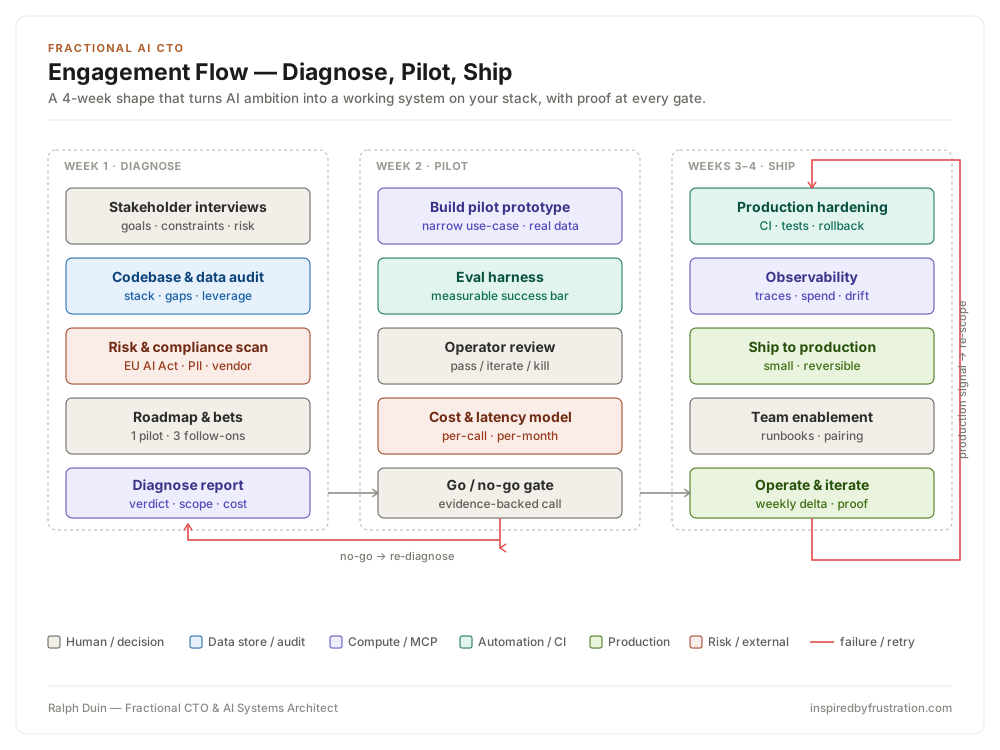
Diagram of a 4-week Fractional AI CTO engagement: Week 1 diagnose, Week 2 pilot, Weeks 3-4 ship and operate, with a red rework loop and a production-signal feedback loop back to scope.
How the 4-week Fractional AI CTO engagement actually runs: diagnose, pilot, ship — with kill gates at every step.

What buyers need to know

How is this different from a Big Four AI strategy deck?

We do not produce decks as the deliverable. Every strategy engagement ends with a working pilot, an eval harness, and a roadmap that traces to real cost and latency numbers from your stack. Big Four work optimises for board defensibility; we optimise for the production signal. If a recommendation cannot be defended on a sales call against a measurable bar, it does not go in the report.

What does the bet selection actually look like?

We map the candidate use cases against three axes: payback (cost saved or revenue moved per call), production fit (does it survive your data, latency, and safety constraints), and reversibility (can we kill it without breaking a workflow). Top three become the pilot shortlist; one goes into the eval harness. The losing two are documented as no-goes with the evidence behind the call — so they do not come back as someone else's idea next quarter.

Why an eval harness inside a strategy engagement?

An AI bet without an eval harness is a feeling. The harness is what turns the strategy into something you can defend to a board, to a regulator, and to a future ops team. We build a small golden set in your domain, wire it to graded outputs, and set the kill gate before the pilot ships. When the harness says no, the bet dies; when it says yes, the implementation phase has a measurable bar from day one.

What proof sits behind the strategy advice?

Production systems we run. AppHandoff is the agent-orchestration MCP server that ships work across about 30 concurrent coding agents on a self-hosted Fly runner fleet — measured at 55 merged PRs a day on average over 30 days, peak 111. MCP Beast routes tool calls through a governed proxy with policy checks. The same operator picking your AI bets is the one who keeps these running. If a recommendation cannot be defended against that real-world ledger, it does not ship to you.

How the work runs

  1. 1

    Week 1 — Diagnose

    Stakeholder interviews, codebase and data audit, risk and compliance scan. Output: a written diagnose report with verdict, scope, and cost — not a 60-slide deck.

  2. 2

    Week 2 — Pilot

    Build the smallest pilot prototype against real data, wire the eval harness, model cost and latency. Operator review at the end of the week: pass, iterate, or kill.

  3. 3

    Weeks 3–4 — Ship

    Production hardening, observability, ship to production small and reversible, runbooks and team enablement. The roadmap then continues with weekly deltas, not quarterly check-ins.

  4. 4

    Carry-on or hand-off

    If the team can carry it, we hand off with the eval harness and the roadmap intact. If the work is bigger, we roll straight into a fractional AI CTO engagement on the same evidence base.

Proof it is production-grade

55

merged PRs/day average, 1 operator

Measured on TeamK2K self-hosted Fly runners over the last 30 days, peak 111 in a day — the same operator picking your AI bets.

100%

engagements end with a working pilot

Strategy that does not ship is a budget review. Every engagement ends with a pilot, an eval harness, and a kill gate — or a documented no-go.

1

operator end to end

Bet selection, risk framing, roadmap, and implementation by one person. No partner-to-junior handoff, no offshore drift.

Have an AI bet on the board this quarter?

Bring the candidate use case — a pilot you are about to fund, a vendor you are about to sign, a build-vs-buy call that has stalled. We will run the diagnose and tell you whether it pays back, on the evidence.

Best-fit hiring paths

CTO with three competing AI bets

You have three candidate use cases and the team is splitting effort. Get one operator to pick the bet, defend the call, and ship the pilot — not a deck that ranks all three.

Book the diagnose

Founder facing a build-vs-buy call

A vendor is on the table, your team thinks it can build it, and you need a credible third party to make the call. We say no to the wrong tool and own the call against the eval.

Architecture review path

Operator inheriting an AI pilot

A pilot is half-shipped, the previous owner left, and you need to decide whether to ship it, rebuild it, or kill it. We diagnose the pilot against a measurable bar in week one.

Pilot rescue path

Short answers for AI search

An AI strategy consultant who does not stay through implementation is selling a deck. Strategy is what survives contact with production.
Bet selection: one pilot, three follow-ons, each with a measurable eval bar. The losing candidates are documented as no-goes so they do not come back next quarter.
Eval harness inside the strategy engagement is what turns an AI bet from a feeling into something a board, a regulator, or a future ops team can defend.
Business judgment picks the bet. The swarm is the engine. One operator, evidence-anchored, no AI-slop verbs.
We do not hand off to another firm — the same operator picking the bets stays through the pilot, the eval, and the production read-out.

Why us

Why us

Operator, not partner-to-junior

One person picks the bets, builds the harness, and watches the production signal. No bench, no offshore drift.

Evidence, not slideware

Every claim traces to a number, a deploy, or a working system. AppHandoff, MCP Beast, and the Fly runner fleet are the receipts.

Strategy through to implementation

The same engagement that picks the bet ships the pilot. We do not write the report and disappear.

// what clients say

Proof from shipped work.

  • We came in with a Lovable prototype and a board deadline. Three weeks later we had a typed backend, real auth, and an MCP server our support agents actually trust. The POC went to production without the usual rewrite tax.

    DaanHead of Engineering

    fintech scale-upPOC → production

  • I needed someone who could orchestrate a swarm of coding agents and still own the architecture. The agent-orchestration setup shipped 40+ PRs in a week — every one reviewed, scoped, and reversible. No hallucinated mess to clean up.

    M.R.Founder

    B2B SaaSagent orchestration at scale

  • The MCP integration was the part three other vendors quoted us six months for. Here it was live in under three weeks — tool schema, OAuth, rate limits, traces, the lot. Our Claude agents finally touch real data safely.

    PriyaVP Product

    healthtech startupMCP integration

Stop picking AI bets in the dark.

Bring the candidate use cases. We will diagnose, build the eval, and ship the pilot — defended on the evidence.

Get in touch

FAQ

FAQ

What does an AI strategy consultant actually do?

An AI strategy consultant maps where AI pays back on your stack, picks the bets, frames the risk (EU AI Act, vendor lock-in, PII), and shapes the roadmap. The honest version of the role also stays through implementation: build the eval harness, ship the pilot, watch the production signal. Strategy that does not ship is a budget review.

How is this different from McKinsey, BCG, or Bain AI strategy work?

Big-firm AI strategy work is optimised for board defensibility and a partner-to-junior delivery model — the partner sells, juniors write the deck. We are one operator end to end, and the deliverable is a working pilot plus an eval harness, not a 60-slide deck. Faster, cheaper, and the strategy is defended against a measurable bar on your stack.

What does an AI strategy engagement cost?

Rate bands published separately — book a 20-minute call for a range against your scope. A 4-week diagnose-pilot-ship engagement is the typical shape; ongoing strategy oversight rolls into a fractional AI CTO retainer on the same evidence base.

What goes wrong with most AI strategy engagements?

The bets are picked without an eval harness, the strategy team hands off to a different implementation team, and the production signal never feeds back into the roadmap. The leading indicator is a deliverable shaped like a PDF instead of a pilot. Mitigation: tie every bet to a measurable bar and keep the same operator through the ship.

How do we start?

1) Book a 20-minute scoping call with the candidate use cases on the table. 2) We run a 1-week diagnose with stakeholder interviews and a codebase and data audit. 3) Week 2 pilot, weeks 3–4 ship. Book at /contact?service=ai-strategy-consulting.